KU Development Foundation

Master in Global Leadership and Geopolitics

Graduate Programs (Master)
City: Warsaw
Duration: 2 years
Language: EN
Obtained title: Master's Level Degree
Full-time
Admission starts 02.03.2026
Adam Miziołek
Deputy Head of Admission Office
Adam Miziołek

About the Studies

About the Studies

Study Objective

The Master in Global Leadership and Geopolitics, programme is a modern response to the challenges of a world shaped by constant disruption, geopolitical risks, and regulatory volatility. Unlike traditional programmes focused exclusively on business or international relations, Master in Global Leadership and Geopolitics integrates strategic management, geopolitics, and risk management, preparing future leaders to operate in an environment of uncertainty.

The mission of the programme is to develop analytical, leadership, and diplomatic skills essential for navigating an unstable world, anticipating risk, and designing resilient strategies in the face of global change.

Scholarships

Open days

About Kozminski University

Practitioners, Not Just Academics

Prof. Grzegorz W. Kołodko

Former Vice Prime Minister and Minister of FinanceKozminski University

An intellectual and politician, academic lecturer, and architect of Poland’s successful post-communist systemic reforms. Author of economic bestsellers and numerous works in the fields of political economy, development policy, and interdisciplinary studies on globalization and international relations, published in twenty-eight languages. The most frequently cited economist from post-communist countries. Founder and director of the TIGER think tank - Transformation, Integration and Globalization Economic Research at Kozminski University in Warsaw. 

Former four-time Deputy Prime Minister and Minister of Finance of Poland. In the past, an expert at the International Monetary Fund and the World Bank, as well as a lecturer at Yale and UCLA, and a visiting professor at many prestigious universities in Europe, Asia, and America. A marathon runner and globetrotter who has visited 172 countries and set foot on Antarctica. 

Prof. Marcin Piątkowski

Kozmiński UniversityLead Economist at the World Bank

Marcin Piatkowski is Professor of Economics at Kozminski University and Lead Economist for South Asia at the World Bank. Previously, he directed World Bank private sector initiatives in China and advised governments across Europe and Asia.  

His distinguished career includes roles as Chief Economist and Managing Director of PKO BP, economist at the IMF European Department, and Advisor to Poland’s Deputy Premier.

A Harvard pre- and post-doctoral scholar, he holds a Ph.D. and habilitation from Kozminski University and an M.A. from the Warsaw School of Economics. Author of the acclaimed Europe’s Growth Champion (Oxford University Press, 2018; 2nd ed. 2025), he received the Polish Academy of Sciences’ "Best Book in Economics" award. A frequent lecturer at institutions like Harvard and Peking University, he leads panels at the World Economic Forum.  

Aleksandra Przegalińska

AI ResearcherKozminski University & Harvard University

Aleksandra Przegalińska is a pioneering figure in artificial intelligence research and academic innovation. She currently serves as Vice-Rector for Innovation and AI at the Academy of Leona Koźmińskiego, where she is also Associate Professor with habilitation in management and organizational sciences. 

Her academic path includes a PhD in the philosophy of artificial intelligence from the University of Warsaw and studies at The New School for Social Research in New York. Since 2016, she has conducted advanced research at the Massachusetts Institute of Technology in Boston and is also a Senior Research Associate at Harvard University’s Center for Labor and a Just Economy. In addition, she acts as Scientific Advisor to Campus AI, contributing her expertise to the development of AI education and research. 

Her research interests cover a broad range of topics in artificial intelligence, with a particular focus on natural language processing, machine learning, social robotics, and wearable technologies. This interdisciplinary expertise allows her to bridge theoretical foundations with practical applications in the rapidly evolving field of AI. 

Joanna Rohozińska

International Relations and Development Professional

Joanna Rohozińska has been engaged for over 25 years in the field of civil society and media programs in the post-communist space, living and working in several countries across the region, often in challenging environments. She has testified before the U.S. House Committee on Foreign Affairs and has spoken as an expert at closed-door briefings and conferences on regional issues. She has been regularly consulted as a regional expert, publishing articles and appearing in conference panels and television programs, as well as speaking on podcasts focused on disinformation and information warfare. 

She currently serves as Regional Director for Central & Eastern Europe at IN2, a specialized communications and research company. She is also a member of the Advisory Group for the Carnegie Endowment’s Partnership for Countering Influence Operations (PCIO) project and sits on the boards of several NGOs in the region. Previously, she was Regional Director for Europe and Eurasia at IREX. She began her career at Freedom House in Budapest and has worked with local organizations, international NGOs, and donor institutions. Immediately prior to IREX, she served as Resident Program Director for Europe and Transatlantic Relations at IRI, where she was responsible for regional programs, including the Beacon Project focused on tracking foreign influence operations and strengthening democratic resilience. She also spent over 10 years at the National Endowment for Democracy, overseeing programs in East-Central Europe and the former Soviet Union. 

She holds a Master’s degree in Russian and European history from the University of Toronto. She is fluent in English, Polish, French, and Russian, with working knowledge of Belarusian and Ukrainian. 

Søren Juul Jørgensen

Senior ResearcherCenter for Human Rights and International JusticeStanford University

Søren Juul Jørgensen is a JD Research Fellow at the Center for Human Rights and International Justice at Stanford University. He is the founder of GAEIA, an international research platform focused on the societal impact of technology, as well as the founder of ForestAvenue, a strategy firm established in Silicon Valley, Brussels, and Copenhagen. 

He previously served as Consul General of Denmark for California and CEO of the Danish Innovation Center in Palo Alto, where he focused on technology innovation and industry engagement, supporting startups, corporate innovation, and research collaboration. He is a former senior diplomat in the Danish Foreign Service, with postings in Brussels, Warsaw, New York, and San Francisco. 

His professional background also includes experience with international technology companies such as Mærsk Data and IBM, as well as work in the green energy sector, where he helped establish Bigadan, a leading Danish RNG/biogas company in the United States. He has also taught law at the University of Copenhagen and continues to serve as a mentor and advisor to tech startups and initiatives. 

Philippe Silberzahn

Professor of StrategyEMYLON Business School

Philippe Silberzahn is a professor at emlyon business school (France). He also teaches at HEC Paris. His work focuses on how organizations manage disruptions, surprises and situations of radical uncertainty. As a keynote speaker, management educator and consultant, he works with the leadership teams of large government and private organizations engaged in transformation efforts when confronted to disruptions in their markets.

He is the author of several books and numerous articles on these topics. He has over twenty years of prior experience as an entrepreneur and CEO in the software industry. He holds an MBA from the London Business School and a PhD in management from the École Polytechnique (France). His latest book in English, “Welcome to uncertainty” was published in September 2023. He is a professor of strategy and co-author of the book "Constructing Cassandra: Reframing Intelligence Failure at the CIA."


Andreas Schaal

Director of Global Relations and Co-operation at the OECDOECD Sherpa to G20/G7/APEC

Andreas Schaal is the Director for OECD Global Relations and Co-operation, as well as the OECD Sherpa to the G7, the G20 and APEC. In these functions, he supports and co-ordinates the OECD’s contributions to global governance under the leadership of OECD Secretary-General Mathias Cormann. In close co-ordination with OECD Members and the OECD’s External Relations Committee, he and his team implement the OECD Global Relations Strategy, engaging with over 100 partner countries around the globe at the ministerial level and building a global level playing field by increasing adherence to OECD standards and policies. Andreas’ expertise includes two decades of conceptional and strategic work on foreign affairs, national, international and global economic policy, and global governance. He is responsible for the OECD’s relations with Brazil, China, India, Indonesia and South Africa as well as with Southeast Asia, Latin America and the Caribbean, South East Europe, Eurasia, and the Middle East and North Africa.

The OECD Global Relations and Cooperation Directorate, which he oversees and manages, includes around 100 team members. Under Andreas’ leadership, it supports the Secretary-General’s objectives for a regionally inclusive and globally relevant Organisation. Between 2013-2016, he served the organisation as the Head of the Sherpa Office and the Global Governance Unit at the OECD and between 2013-2018 as the G20 Sous Sherpa. Since joining the OECD in 2008, he has also held positions as a Senior Policy Analyst in the Investment Division of the Directorate for Financial Markets and Enterprise Affairs, and as Counsellor in the Office of the Secretary General.

Prior to joining the OECD, Mr Schaal held various positions during his work for the German Federal Government, including: Deputy Director G8 Summit/German Sherpa Office, Federal Ministry of Economic Affairs and Technology; Economic Counsellor, German Permanent Delegation to the OECD, Paris; Vice Chair (elected 2005-2006) of the OECD’s Economic and Development Review Committee (EDRC); and Policy Advisor and Chief of Staff to Parliamentary Secretary of State Siegmar Mosdorf, MP, Federal Ministry of Economic Affairs and Technology.

Andreas Schaal is a non-Resident Senior Fellow of the Chongyang Institute for Financial Studies at Renmin University of China (RDCY). A German national, he holds a Masters in Public Policy and Public Management from the University of Konstanz, Germany

Bart Piasecki

Assistant DirectorGeoEconomics CentreAtlantic Council

Bart Piasecki is an economist with extensive expertise in international economic policy, providing in-depth macroeconomic analysis and strategic advice to support decision-making at the executive board level. He is recognized for his deep understanding of international financial systems and the interplay between global markets, multilateral institutions, and public policy. He has experience collaborating with governments, NGOs, international organizations, and financial institutions worldwide. 

He holds a Master’s degree in Business Administration from WSB University and completed executive education at the Stanford Graduate School of Business. 

Amb. Pierre Andrieu

Former Ambassador of FranceSenior Fellow on China-Russia RelationsAsia Society

Pierre Andrieu is a former French Ambassador and a senior expert on China–Russia relations. Over a distinguished career at the French Ministry of Foreign Affairs, he held key positions across Europe and Asia, including Ambassador to Moldova and Tajikistan, as well as French Co-Chair of the OSCE Minsk Group, where he led negotiations on the Nagorno-Karabakh conflict. 

He brings extensive academic experience, having taught international relations, European affairs, and Russian foreign policy at leading institutions such as Sciences Po, ESCP Business School, and IRIS. His expertise spans EU policy, Eastern Europe, Russia, and Asia, combining strategic insight with hands-on diplomatic practice. 

Within the Master in Global Leadership and Geopolitics, Pierre Andrieu offers a unique practitioner’s perspective on global affairs, leadership in complex environments, and high-level international negotiation. 

DR MILO JONES

Senior Advisor for Geopolitics and TechnologyVisiting Research Fellow, Oxford University

Dr. Milo Jones is a Visiting Research Fellow at the Changing Character of War Centre, Oxford, and Senior Advisor for Geopolitics and Technology to Arcano Partners and Clearway Capital. An expert in the impact of technology on geopolitics, he serves on the board of a major US firm and provides high-level executive consultancy. He authored Constructing Cassandra: Reframing Intelligence Failure at the CIA, 1947–2001 (Stanford University Press, 2013). 

Formerly a Senior Manager at Accenture and stockbroker at Morgan Stanley, Dr. Jones also served as a US Marine Corps officer and Airborne graduate. He holds a PhD and MA from the University of Kent, an MBA from London Business School, and a BA from Northwestern. He is a Fellow of the Salzburg Global Seminar and a member of the IISS and AFIO. He resides in Poland and France, bringing decades of investment and strategic expertise. 

PROGRAM HIGHLIGHTS

1
INTERDISCIPLINARY COMBINATION OF EXPERTISE FROM MULTIPLE FIELDS

The programme offers a unique combination of knowledge in international relations, geopolitics, economics, strategic communication, and global decision-making processes. 

It is designed to provide students with a deep understanding of dynamic political and economic processes in a multipolar world, shaped by global tensions, disruptions, and transformative change.

2
STRONG PRACTICAL DIMENSION AND EXPERT-LED TEACHING

Courses are delivered by renowned experts from leading academic and analytical institutions, including emlyon Business School, Imperial College London, and Stanford University, as well as think tanks such as the Atlantic Council and Asia Society. 

The faculty also includes former international and Polish diplomats, as well as former prime ministers and ministers.The programme is grounded in active learning and employs innovative teaching methods, including a Game-Based Lab (decision-making and simulation games) and a Project-Based Studio, where participants work on real-world strategic challenges. This approach enables students to develop strong analytical, negotiation, and decision-making skills in realistic global contexts.

3
CURRICULUM ALIGNED WITH TECHNOLOGICAL AND DIGITAL CHALLENGES

The curriculum addresses current global challenges by offering courses in areas such as Cyber Defence Diplomacy, the Geopolitics of Data, Narrative Power, and the management of risks related to artificial intelligence (AI).

Students acquire competencies essential for operating in environments strongly shaped by data, technology, and new forms of geopolitical influence.

4
MANDATORY PROFESSIONAL INTERNSHIP IN THE FINAL SEMESTER

An integral part of the programme is a compulsory internship completed in the fourth semester. It allows students to gain hands-on professional experience, build industry networks, and verify their analytical and leadership skills prior to the master’s thesis defence.

5
ACCESS TO THE GLOBAL GNAM NETWORK AND INTERNATIONAL EXCHANGE OPPORTUNITIES

As the only university in this part of Europe, Kozminski University is a member of the Global Network for Advanced Management (GNAM) - a consortium of 33 leading business schools coordinated by Yale University. Students have the opportunity to participate in global programmes and initiatives jointly delivered with partner institutions worldwide.

6
PROGRAMME DELIVERED BY A HIGHLY RANKED BUSINESS SCHOOL

Kozminski University is the only Polish institution, and one of the top two in Central and Eastern Europe, to be ranked in the Financial Times - Masters in Management 2025 among the world’s top 100 business schools. The programme combines the highest academic standards with the demands of the international labour market.

7
ADVANCED DIGITAL LEADERSHIP SKILLS

The program features unique courses in digital education, equipping you with expertise in business analytics for managers and building business applications with automation elements. Learn to make data-driven decisions and implement technology solutions that enhance organizational performance.

Program

Students have two unique development paths to choose from, which allow them to tailor their education to their professional goals:

Global Affairs & Strategic Diplomacy: The programme focuses on the analysis of political processes, international competition, and the role of global organisations. It prepares graduates for careers in institutions dealing with international security, foreign policy, and strategic analysis—both in the public sector and in think tanks or international organisations.

International Business & Corporate Diplomacy: The programme focuses on the relationship between the corporate sector and states, as well as on managing regulatory and geopolitical risk in the international business environment. It prepares graduates for careers in global companies, public affairs departments, think tanks, and institutions specialising in risk analysis and international strategy.

The programme is built around four core thematic pillars: Leadership and Diplomacy (23%), Strategy (23%), Geopolitics (23%), and Risk Analysis (30%).
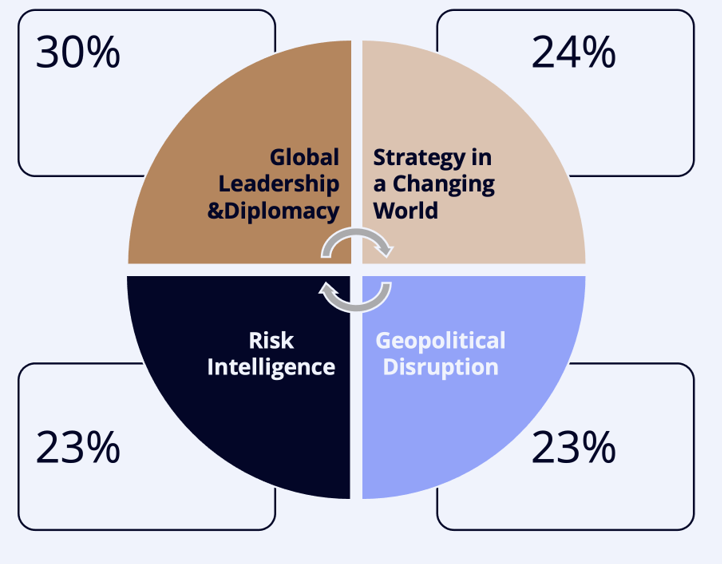
*The study program will be launched provided that a minimum of 17 students enroll. 

Class schedule

Full-time programs: Classes take place from Monday to Friday in the morning and in the afternoon. 

Career prospects

Global Affairs & Strategic Diplomacy:

  • In international organizations such as the UN, EU, NATO, OECD, and the Three Seas Initiative.
  • In government agencies, including Ministries of Foreign Affairs, Ministries of Defence, institutions dealing with development cooperation, and intelligence and security agencies.
  • In diplomatic and consular services, as well as in international humanitarian organizations and peacekeeping missions.
  • In the analytical sector, encompassing global NGOs, foundations, think tanks, and research institutes engaged in political and strategic analysis.
  • In innovative companies planning expansion into foreign markets that require expertise in digital diplomacy and political risk analysis.

International Business & Corporate Diplomacy:

  • International corporations and consulting firms, particularly in departments dealing with strategy, global markets, and risk management.
  • Specialized corporate departments such as Public Affairs, Compliance, Corporate Diplomacy, and lobbying.
  • The financial sector, including banks and institutions operating in unstable regions or emerging markets.
  • Consulting firms specializing in geostrategy, geopolitics, and foresight (strategic forecasting).

A WORD FROM THE PROGRAM DIRECTOR

dr Alina Landowska

Understanding global power shifts is important, but what truly matters is learning how to lead in a changing world. The Master in Global Leadership and Geopolitics is designed for students who want to shape global decisions, not only analyze them. The program combines leadership, geopolitics, risk and strategy with a strong focus on practical experience. Students work closely with international experts, diplomats and business leaders while taking part in simulations, strategic projects and leadership workshops. In the final semester, each student develops an individual project under academic and professional mentorship, focused on a real strategic challenge. The future is uncertain, but your leadership does not have to be. We invite you to join us and lead globally.

Admission

The employees of the Admission Office are available during the office hours (9:00 - 16:00 from Monday till Friday), via e-mail ([email protected]) or by calling +48 22 519 22 61. You can also visit the Admission Office in person - book an appointment here. The Office will be unavailable between 04-07.06.2026. Admission for full-time and part-time Master programs at Kozminski University is based on 2 criteria: GPA on your previous studies and results of an online entry test. Maximum score is 100 points - 50 points for the test and 50 for GPA. Candidates who scored at least 60 points from both criteria will be qualified to the program.

Entry Test

The entry test is scheduled for 40 minutes and is meant to check the background of the candidate, analytical and logical thinking skills, as well as, possession of basic knowledge in the field, corresponding to the knowledge a Business-related Bachelor alumni should possess. Test is composed of 25 close-ended questions - 10 quantitative questions, 10 on general knowledge and current world situation and 5 on specialized knowledge in Business.

Application for full time and part time Master's programs at Kozminski University must include:

  • application form - complete the form online and attach required documents,
  • original Bachelor/Master degree diploma or notarized copy and transcript of records (translation of the documents into Polish or English)
  • written information from the director of NAWA confirming the diploma entitling the holder to apply for admission to studies OR a decision on nostrification – does not apply to diplomas issued in the European Union, EFTA, OECD More information
  • copy of the national ID or a passport 
  • CV in English
  • proof of payment of the admission fee (non-refundable)
  • certificate confirming proficiency in English:
    • IELTS Academic certificate – at least 6,5 overall band;
    • TOEFL iBT certificate - at least 87 points;
    • TOEIC certificate – at least 785 points in "Listening & Reading" and 150 points in "Speaking" and 160 points in "Writing";
    • LanguageCert (PeopleCert Qualifications (PCQ)): LanguageCert International ESOL Communicator B2 (4-skill exam) or higher, LanguageCert Academic B2 or higher, LanguageCert Test of English B2 or higher (Use the university promo code 01F126 when booking your exam at www.languagecert.org to receive 10% off the exam fee. Exams can be taken online from home, anywhere in the world.);
    • Cambridge certificates: B2 First (FCE), C1 Advanced (CAE), C2 Proficiency (CPE), B2 Business Vantage (BEC Vantage), C1 Business Higher, Certificate in English for International Business and Trade (CEIBT);
    • Pearson Assessment English: Pearson English International Certificate - Level 3, Pearson Test of English Academic - at least 59 points;
    • LCCI certificates: English for Business Level 2 or higher, Foundation Certificate for Teachers of Business English (FTBE);
    • European Consortium for the Certificate of Attainment in Modern Languages – Level B2 (Vantage) or higher;
    • telc GmbH certificates: Certificate in English, Certificate in English for Business Purposes, Certificate in English for Technical Purposes, telc English, telc English Business, telc English Technical, telc English University;
    • Trinity College London: ESOL Skills for Life – Level 1 (B2) or higher, Integrated Skills in English (ISE) – ISE II or higher, ISE Digital – above 80 points (B2).

Applicants may be exempt from submitting a certificate of English proficiency if they meet any of the following conditions:

  • Obtained at least 95% at the basic level or 80% at the extended level in English on the Polish Matura exam;
  • Hold an International Baccalaureate (IB) or European Baccalaureate (EB) high school diploma or completed bachelor/master degree in English in an EU or EFTA country, or in the UK, Ireland, the USA, Canada, Australia, or New Zealand;

In case of visa, accommodations and other daily issues we encourage to contact our Welcome Point. 

Foreigners who need a visa to study in Poland are additionally required to make payment of tuition for one full year of studies before we can issue documents necessary in the visa application process i.e. invitation to come to Poland and the admission decision.

Candidates applying to Master programs based on documents issued in countries outside European Union, EFTA, OECD must also submit written information from the director of NAWA about the degree certificate confirming eligibility to apply for studies OR the nostrification decision (not applicable to documents issued in European Union, EFTA, OECD).  More information on the procedure is available on the website of National Agency for Academic Exchange (NAWA).

Admission commission issues a conditional acceptance letter, including an individual account number, to which the payment should be transferred in Polish Złoty (PLN), calculated according to the exchange rates of the National Bank of Poland (www.nbp.pl ). In case the candidate is denied a visa, tuition is returned.

Admission fee is non-refundable.

1
Create your account

Start your university journey today! Simply create an account on our admission portal and start filling in the application form.

2
Complete the Application form and upload your documents

Fill in the application form with required data. Upload the scans of necessary documents to the admission portal. Scans must be clear, legible and of good quality, otherwise they will not be accepted in the admissions process. You can use free applications such as Camscanner.

Make sure the photo meets the official requirements described in the application form (format as national ID or passport photo).

3
Document Review & Qualification Test

Once you submit your application, the Admission Committee will carefully review your documents. If your application meets the requirements, you will be invited to take the online admission test. Our Examination Center will reach out to you to schedule the test.

4
Entry Test

The entry test is an assessment designed to evaluate your academic background, analytical and logical thinking skills, and foundational knowledge in the field. It aligns with the level of understanding expected from a graduate of a business-related bachelor’s program.

5
Admission Decision

Admission for Master programs at Kozminski University is based on 2 criteria: GPA on your previous studies and results of an online entry test. Each criteria is worth up to 50 points. Candidates who scored at least 60 points from both criteria and fulfil other requirements will be qualified to the program.

6
Admission decision and formalities

You will be informed about admission outcome via e-mail. If you are accepted you’ll receive an electronic agreement to sign and detailed instructions on completing the admission process, regarding submitting documents and covering tuition. All required documents must be submitted in a complete package to the Admissions Office (in person or via post).

7
Welcome Aboard!

After you complete above mentioned steps and cover tuition fee the admission process is concluded and you can await for your first classes.

If you need any extra documentation (e.g. for a visa), reach out to us – we are here to help. 

Tuition and fees

Master in Global Leadership and Geopolitics - full-time
1st year 2nd year
Tuition fee per month - 10 installments per year 3 980 PLN 4 380 PLN
Tuition fee per semester in full - 2 semesters per year 19 400 PLN 21 400 PLN
Tuition fee per year in full 38 800 PLN 42 800 PLN
Admission fee 100 PLN

Bank account number to which the admission fee should be paid:

PEKAO S.A. II O/Warszawa 20 1240 1024 1111 0010 1646 0637 

SWIFT Code: PKOPPLPW 

IBAN: PL 

After signing the agreement, each student will receive an individual bank account number to which tuition fees should be paid.